Fluoride Therapies in Caries Prevention: An Updated Evidence Review
Abstract
Dental caries remains a major global oral health problem, and fluoride therapy continues to be the most effective and evidence-based preventive strategy. This review evaluated the mechanisms, delivery methods, clinical effectiveness, safety, and recent advances in fluoride therapies for caries prevention. Fluoride enhances enamel remineralization, inhibits demineralization, and suppresses cariogenic bacterial activity. Systemic fluoride methods such as water fluoridation and topical therapies including fluoridated dentifrices, varnishes, gels, foams, mouth rinses, and high-fluoride toothpastes have demonstrated significant reductions in caries prevalence. Silver diamine fluoride has also emerged as an effective minimally invasive option for arresting active carious lesions. Although fluoride is highly effective, proper dosage and supervised use are important to minimize the risk of dental fluorosis. Recent advances involving fluoride-releasing materials, calcium-phosphate systems, and personalized risk-based approaches are further improving preventive outcomes. Overall, fluoride therapies remain the cornerstone of modern caries prevention and support sustainable, minimally invasive oral healthcare strategies.
Introduction
Dental caries is still among the most common chronic diseases across the globe with all the very high prevalence ages notwithstanding the immense development witnessed in the area of preventive dentistry [1]. It is a multifactorial disease that is caused by an active interaction of cariogenic microorganisms, fermentable carbohydrates, host factors, and time [2]. Despite the fact that restorative methods are able to deal with the implications of caries, prevention is still the key to oral health in the longterm [3]. Among all the preventive measures, fluoride therapy remains the most widely researched, economical and evidence-based caries prevention intervention [4]. Fluoride has anticariogenic effect that occurs in several ways whereby it increases enamel remineralization, demineralization and bacterial metabolism [5]. On the tooth surface, fluoride enhances the development of fluorapatite or fluorhydroxyapatite that is less dissolvable in acid compared to hydroxyapatite [6]. Further, fluoride disrupts the cariogenic bacteria like Streptococcus mutans enzyme activity and decreases the production of acid and biofilm virulence [7]. These processes act at low chronic fluoride levels mostly and it is significant that topical doses of fluoride need to be taken often, but not in large amounts [8]. Community based fluoride delivery systems such as water fluoridation, fluoridated salt and milk fluoridation programs have over the last few decades contributed a great deal to the caries prevalence among the people [9]. The prevalence of fluoride-containing dentifrice on the other hand has led to significant caries reduction on a global scale [10]. Nevertheless, the shifting epidemiology of dental caries, polarisation of caries, more caries in old age of the roots, and caries in early childhood of high-risk groups requires a re-evaluation of the means of delivering fluoride and its efficacy in clinical practice [11]. There is a multitude of professional and over-the-counter professional and self-administered fluoride treatments in modern dental practice, such as fluoride varnishes, fluoride gels, fluoride foams, fluoride mouth rinses, silver diamine fluoride, and high-fluoride prescription dentifrices [12]. Their preventive capacity has been further amplified by the development of fluoride formulations, delivery vehicles and application guidelines [13]. Besides, fluoride treatments are also becoming a part of risk-based caries management strategies, and this approach is consistent with contemporary ideas of minimal intervention dentistry and personalized oral healthcare [14]. The strong body of evidence that supports the use of fluorides notwithstanding, issues surrounding dental fluorosis, the correct dose and safety especially among the children still find their way into the minds of the people and the medical fraternity when making such a choice [15]. Furthermore, the new evidence of new fluoride compounds, bioactive materials, and the combination of these materials and calcium-phosphate technologies presents the necessity of new and more thorough assessment of fluoride therapies [16]. Thus, the purpose of this review is a critical and synthesizing examination of the existing evidence on fluoride therapies in the prevention of carries, including their modes of action, modes of delivery, clinical effectiveness and safety [17]. This review aims to inform clinicians, researchers, and policymakers to maximize the benefits of fluoride use in the effective and sustainable caries prevention of various populations by offering a new evidence-based look at the issue [18].Materials and Methods
Dental caries is still among the most common chronic diseases across the globe with all the very high prevalence ages notwithstanding the immense development witnessed in the area of preventive dentistry [2]. It is a multifactorial disease that is caused by an active interaction of cariogenic microorganisms, fermentable carbohydrates, host factors, and time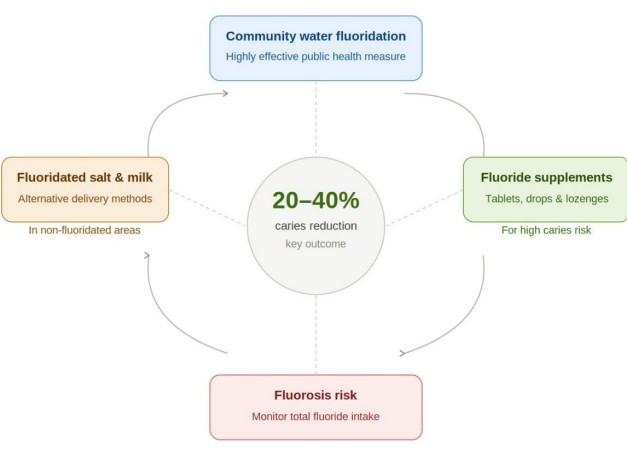
Results
ResultsDiscussion
DiscussionConclusion
ConclusionAcknowledgements
Acknowledgment.References
- Rathee M, Sapra A. StatPearls [Internet]. StatPearls Publishing; 2025.
- Giacaman RA et al. Front Oral Health 24.3 (2022): 764479. [PMID: 36092137]
- Veiga N et al. Healthcare (Basel) 11.11 (2023): 1635. [PMID: 37297776]
- Nassar Y, Brizuela M. StatPearls [Internet]. StatPearls Publishing; 2025.
- Aspiras M et al. Int J Dent 2010 (2010): 651869. [PMID: 20445763]
- Amaechi BT et al. BDJ Open 5.18 (2019). [PMID: 31839988]
- Zhang K et al. Front Cell Infect Microbiol 28.12 (2022): 801569. [PMID: 35295758]
- Aoun A et al. Prev Nutr Food Sci 23.3 (2018): 171-180. [PMID: 30386744]